| |
| Note:
The following is used with the permission of the original
author.
|
|
Section
4: Evaluating Risk and Reward
over the next five years
-
Choosing a Future High Price
- Now, you will calculate the High Price that the stock
is forecasted to reach in the next five years. The
price is calculated by multiplying the Average High
Price/Earnings Ratio (from Section 3, Row 7, Column
D) by the Estimated High Earnings Per Share.

A common question from beginners
is, "Where do
I get the "Estimated High Earnings Per Share" for
this calculation?" The answer is from the trend
line you drew on Page 1 of the SSG form. Find the
point where the EPS trend line you drew intersected
with the last year on the graph -- that's your
projection of the stock's high EPS over the next
five years.
However, before you calculate
the High Price, you should apply some judgment
to the selection of a future Average High Price/Earnings
Ratio, rather than blithely filling in the blank
from the default value.
A stock's P/E Ratio reflects
the market's expectations of that stock's future
growth, so a company that is growing very rapidly
will have a Price/Earnings Ratio that is also
very high. Over time, it is very rare for a company
to maintain annual earnings growth more than
30%, and as that growth inevitably slows, the
P/E Ratio will decline as well. In addition,
companies with high P/E Ratios are susceptible
to severe "corrections" if the company's earnings
miss analysts' expectations for a single quarter.
If you accept a High P/E Ratio that is very high,
you will set a Future High Price target that the
stock will unlikely reach.
Well, how high is too high? Ralph Seger,
the Repair Shop columnist from Better
Investing magazine, often says that, as high
P/E Ratios discount the future, very high P/E
Ratios discount the hereafter as well! He advises
investors never to project a future High Price/Earnings
Ratio that is greater than 20.
While this may be a conservative approach, in
any case, a High P/E Ratio that's higher than 25
should give a prudent investor cause to re-evaluate
the choice. By cautiously selecting a High P/E
Ratio that best reflect's the company's future
growth, you can avoid a nasty surprise later on.
-
Choosing a Low Price
- The SSG form gives you four
options for a Future Low Price.
You can choose one of the four
choices, or select an altogether
different low price.
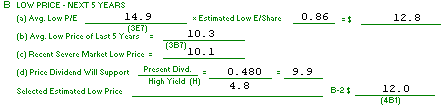
- This choice
is derived from the Average
Low P/E Ratio (from the
Section 3 chart, Row
7, Column E) and the
Estimated Low Earnings
Per Share.
Again,
you should always
apply judgment to
the choice of a Low
P/E Ratio, just as
you did in the choice
of a High P/E Ratio.
If the stock's Average
Low P/E Ratio is
more than 15 or 20,
that might signal
a downward revision.
The
Estimated Low Earnings
Per Share also generates
confusion because
this figure appears
nowhere on the SSG
form. The "by-the-book" method
of analysis suggest
using the most recent
year's EPS, on the
assumption that a
growth company's
most recent year's
EPS will always be
the lowest of the
coming five years,
as the company continues
to increase its earnings.
For fast-growing
companies, you may
wish to use the EPS
from the most recent
four quarters, in
lieu of the most
recent year's. This
takes the assumption
of growth one step
further, and will
give you a Low Price
choice that is, in
most cases, very
reasonable.
- The "Average
Low
Price
of
the
Last
Five
Years" is
found
in
Row
7,
Column
B,
of
the
chart
in
Section
3.
- The "Recent
Severe
Market
Low
Price" requires
you
to
select
a
Low
Price
from
the
Section
3
chart,
depending
on
what
you
consider "recent." Some
investors
consider
the
last
five
years
to
be
recent,
some
only
look
at
the
last
three
years.
You
must
use
your
own
judgment
in
selecting
a
low
price
here.
- The "Price
Dividend
Will
Support" is
calculated
by
dividing
the
Present
Dividend
(for
the
entire
year,
often
referred
to
as
the "indicated
dividend")
by
your
choice
of
a
High
Yield
from
Column
H
in
Section
3.
Usually,
you
will
use
the
most
recent
year's
High
Yield,
but
you
must
apply
your
own
judgment.
This
choice
is
relevant
when
a
stock
is
being
purchased
because
of
its
dividend
income
potential,
and
is
not
very
helpful
in
choosing
a
low
price
for
a
growth
stock.
After
making these calculations,
you must select the stock's
Future Low Price. Remember,
to paraphrase Peter Lynch, "a
stock's price can always
go down until it hits zero." While
you don't have to worry about
this possibility with most
growth stocks, you should
always carefully consider
your choice of a Low Price.
Some investors always choose
a Low Price that is at least
10% to 25% below the current
price, to give a buffer in
case of a general market
correction. Other investors
find that the Low Price calculated
by multiplying the Average
Low P/E Ratio by the Low
EPS is the most realistic.
Whatever your choice, your
Low Price should never be
higher than the stock's current
price.
-
Zoning
- The
next step
in the
SSG is
to calculate
three
price zones
between
the Forecast
Low and
High Prices:
BUY, MAYBE
and SELL.
This entails
subtracting
the Forecast
Low Price
from the
Forecast
High Price,
then dividing
the result
by
3.
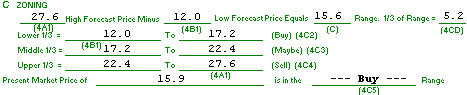
Now,
fill
in
your
Future
Low
Price
in
the
first
blank
in
the
Lower
1/3
line.
Add "1/3
of Range" to
the
Low Price
to discover
the
top of
the BUY
zone,
and
fill
it in
the
appropriate
blank,
as well
as on
the
next
line
as the
bottom
of the
middle,
MAYBE
zone.
Next,
add 1/3
of Range
to the
top of
the BUY
zone
to reach
the top
of the
MAYBE
zone.
Fill
in this
figure,
and as
the bottom
of the
SELL
zone.
Finally,
fill
in your
Forecast
High
Price
as the
top of
the SELL
zone.
Note:
Some
experienced
investors
divide
the
Zones
into
four
parts,
with
the
bottom
25%
as
the
BUY
zone,
the
middle
50%
is
the
MAYBE
zone
and
the
top
25%
is
the
SELL
zone.
This
makes
the
price
at
top
of
the
BUY
zone
equal
to
a 3:1
Upside/Downside
Ratio.
This
advanced
technique
applies
a more
stringent
criteria
to
the
stock.
-
Upside/Downside
Ratio
- The
Upside/Downside
Ratio
compares
the
potential
gain
if
the
stock
reaches
your
Forecast
High
Price
from
the
Current
Price
(the "Upside"),
to
the
potential
loss
if
the
stock
drops
to
your
Forecast
Low
Price
(the "Downside").

A
$10
stock
with
a
Low
Price
of
$5
and
a
High
Price
of
$15
has
an
equal
chance
of
gaining
$5
or
losing
$5
--
a
1:1
Upside/Downside
Ratio.
A
$10
stock
with
a
high
price
of
$20
and
a
low
price
of
$5
has
a
2:1
Upside/Downside
Ratio,
or
twice
the
potential
on
the
Upside
as
on
the
Downside.
The
NAIC
recommends
that
you
only
purchase
stocks
with
a
3:1
Upside/Downside
Ratio.
Many
investors
will
reject
an
Upside/Downside
that
is
greater
than
12
or
15
to
1,
reconsidering
their
choices
of
High
and
Low
Prices.
For
the
calculation,
subtract
the
Present
Price
from
the
High
Price,
and
subtract
the
Low
Price
from
the
Present
Price.
Divide
these
two
figures,
and
the
result
is
the
Upside/Downside
Ratio.
-
Interpreting
the
Results
- Zoning
often
confuses
beginning
investors
because
a
stock
in
the
BUY
zone
may
not
always
be
a
stock
to
BUY.
Some
other
criteria
to
look
for:
- Upside/Downside
Ratio
greater
than
3:1.
- Relative
Value
less
than
100%. (In
other
words,
the
stock's
current
P/E
Ratio
is
less
than
the
Average
P/E
Ratio.)
- Price
in
BUY
zone. (Some
investors
require
the
stock's
price
to
be
in
the
lower
half
of
the
BUY
zone,
or
use
the
25%-50%-25%
zoning
method
described
above.)
- Price
is
forecast
to
double
in
the
next
five
years. (This
roughly
represents
a
15%
annual
return
on
your
initial
investment,
before
dividends
are
calculated.)
If the stock you are studying does not pay dividends, you
can stop here! Otherwise, continue to Section 5: 5-Year
Potential.
|
|
| |
|
|
*
This site not affiliated with the National Association of Investors
Corporation (“NAIC”) in any way, nor does NAIC
sponsor or endorse this web site or any of the products or
services offered herein.
The author founded a successful investment club and has been a member of NAIC
since 1990.
Stock
Investment Guide, SIG, Portfolio Analysis Review, Comparison
Analysis Review,
CAR, and PAR are trademarks of Churr Software.
|
|